


 Would you like us to call you back? It's free!


Culture and heritage
Menton, a city of culture in the heart of the Riviera
From the sweetness of a lemon picked on a hillside to the discreet elegance of ancient palaces, Menton reveals itself like an open book, page after page. Here you will encounter Jean Cocteau, royalty, musicians celebrating, artisans, and builders... All have left their mark, visible or invisible, in the streets, gardens, places of worship, and museums. Here is a brief overview of what awaits you.

The Menton lemon: a rich history
Under the Riviera sun, a unique fragrance fills the air: that of the Menton lemon. Its golden skin and sweet, fragrant flesh carry with them five hundred years of history. Cultivated since the 15th century, it has long traveled far beyond the Mediterranean, saving sailors from scurvy and tantalizing palates as far away as Russia. In the 19th century, thousands of lemon trees covered the hillsides. Frost, followed by the rise of tourism, put an end to this abundance.

Lemons today: rarity and flavor
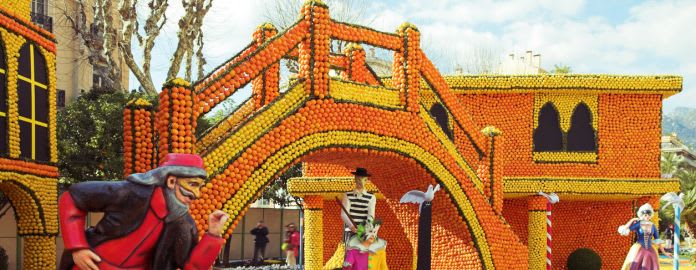
Today, this rare fruit, protected by Protected Geographical Indication status since 2015, remains the emblem of the city. A few enthusiasts continue to cultivate it with patience and high standards. Every winter, the Lemon Festival® lights up Menton, transforming the streets into a temporary garden where the fruit becomes sculptures and a source of celebration. You will see it in the terraced orchards on the hillside before finding it on market stalls or on your plate, in a fragrant tart (carefully prepared by our chef), in liqueur, or in sunny jam.
The charm of the Old Town
A maze of narrow streets leads you to the heart of the Old Town, with its pastel-colored facades, wooden shutters, and flower-filled balconies. Rue Saint-Michel, an iconic pedestrian street, is lined with artisan shops and fragrant stalls inviting you to sample local products. On Place des Marronniers, you can enjoy homemade ice cream in the shade of the plane trees. Further up, Rue Longue unfurls its ancient cobblestones and colorful houses, leading to the 17th-century Chapelle des Pénitents Blancs, guardian of Menton's memory.


In the footsteps of Jean Cocteau
Jean Cocteau left a deep and colorful mark. At the Bastion, a former fort overlooking the sea, he created a living space, decorating even the pebbles on the floor as if to invite the ocean to interact with his works. “It's not a museum,” he said, but a space where art breathes and transforms. More intimate, the wedding hall of the Town Hall, painted between 1956 and 1958, celebrates Orpheus and Eurydice, but also love in all its forms. Two places, two bursts of poetry offered by an artist who made Menton his stage of expression.

A new museum on hold
In 2005, the city of Menton received an exceptional donation: nearly 1,800 works by Jean Cocteau bequeathed by collector Séverin Wunderman. They were housed in a museum designed by architect Rudy Ricciotti, which opened in 2011, facing the sea. But this proximity to the Mediterranean resulted in flooding in 2018. Since then, the building has been closed. Reopening is scheduled for 2030...
The palaces of Menton, memories of the Belle Époque
Under the bright skies of the Riviera, Menton retains traces of a golden age. At the turn of the 19th and 20th centuries, sumptuous palaces were built to welcome winter visitors from all over Europe. Aristocrats, nobles, and royalty sought out the mild Mediterranean climate. Today, a stroll through the city reveals these majestic facades, marked by the Cercle des Palaces Retrouvés (Circle of Rediscovered Palaces). Some have become private residences, while others still house working hotels.
The Balmoral, elegance by the sea
This prestigious palace—where the iconic Sarah Bernhardt stayed at the end of the 19th century—was inaugurated in 1958, along the Promenade du Soleil. From the outset, it attracted an illustrious clientele: Archduke Albert of Austria, Prince Jaime of Bourbon, and the Cáceres family from Venezuela... all seduced by its grandeur and the panoramic view it offers over the Mediterranean. Even today, its Belle Époque silhouette remains a familiar feature of the Menton landscape. With Vacances Bleues, this renovated palace continues to welcome those seeking beauty with the sea in their sights.


The Royal Westminster, former Belle Époque palace
Built in 1870, the Royal Westminster has welcomed European nobility who came to spend the winter under the Menton sky. The Baroness d'Alexandry d'Orengiani stayed there for long periods, as did students from the famous Berlin music school. Expanded and embellished over the decades, it still retains the majestic lines of its Belle Époque architecture: arched windows, engaged columns, sculpted pediments... Located facing the sea, in the heart of the city, it embodies a certain gentle way of life, with an elegance that is constantly renewed.


The Basilica of Saint Michael Archange
Its famous bell tower rises above the Old Town, between sky and sea. Since 1639, the Basilica of Saint Michael Archange has watched over Menton, draped in shades of ochre and orange. The cobbled forecourt offers a view of the Baie des Sablettes. In summer, the Menton Festival takes over the basilica, and music and its accompanying emotions resonate under the vaults. The Chapel of the White Penitents, right next door, extends this harmony of stone and silence.

Saint-Michel Cathedral in Sospel
In Sospel, Baroque architecture takes root in the heart of the village. Behind its peaceful façade, Saint-Michel Cathedral, a listed historical monument, displays gilding, paintings, and trompe-l'oeil in a majestic setting. It is one of the largest Baroque churches in the Alpes-Maritimes. During concerts, the Agati brothers' organ fills the nave with melodies from Italy.

Monaco: for a day of prestige
Just a stone's throw from Menton, Monaco reveals its splendor: the Rock and its Palace, the bustling yacht harbor, the gardens of Saint-Martin, the infinite ocean of the Oceanographic Museum, the calm of Fontvieille, and the elegance of the Carré d'Or. Between culture, strolling, and shopping, the Principality charms at every turn.

Nice, city of art and history
Listed as a UNESCO World Heritage Site, Nice combines cosmopolitan influences with Mediterranean elegance. Its streets feature Belle Époque architecture alongside Baroque, Art Deco, and modern designs. Old Nice can be explored on foot: yellow and ochre facades, artisans' workshops, the scent of socca and orange blossom... The Cours Saleya market displays its colors under the arcades. Higher up, the Castle Hill offers a breathtaking view of the old town, the port, and the Bay of Angels. In the museums, paintings by Matisse and Chagall remind us that Nice is also a land of inspiration.

